Editors’ Choice ∙ Architecture as Time-Based Art ∙ Rion Willard
Second in the matzine Editors’ Choice series is Rion Willard’s ‘Architecture as Time Based Art’, from matzine 07 – The Hourglass Issue (ed. Seán McAlister).
From ‘cartesian solidity’ to the ‘spatial geometry of dance’, this short essay considers the possibility of architecture as ‘perpetual performance’, and the ways in which scores for both music and dance could provoke for the architect alternative methods in the representation of space. Furthermore, the sentences employ a dimension often excluded from analysis of architecture – ‘time’. In referencing Pask’s Conversation Theory, the essay also encourages the reader to consider the nature of the dialogue which must exist to bring about architecture – the’conversation’ which defines and describes our position within our physical and cultural environments, locating us within a particular chronology, whether it is within a grand narrative or the extraordinary quotidian.
What form does this dialogue take, and can it be described graphically, in the form of notation? What other forms of discussion and inquiry might exist, and are drawings capable of hosting this exchange, without the support of text? Is producing a collaborative ‘little magazine’ in architecture one form of this dialogue, and are buildings another? “If architecture is anything at all”, proposed Douglas Darden, “it is a form of inquiry” – the words and images below illustrate that each can contribute to the dialogue of architecture in equal – and elegant – measure.
Ian Pollard
_______________________________________
Architecture as Time-Based Art ∙ Rion Willard
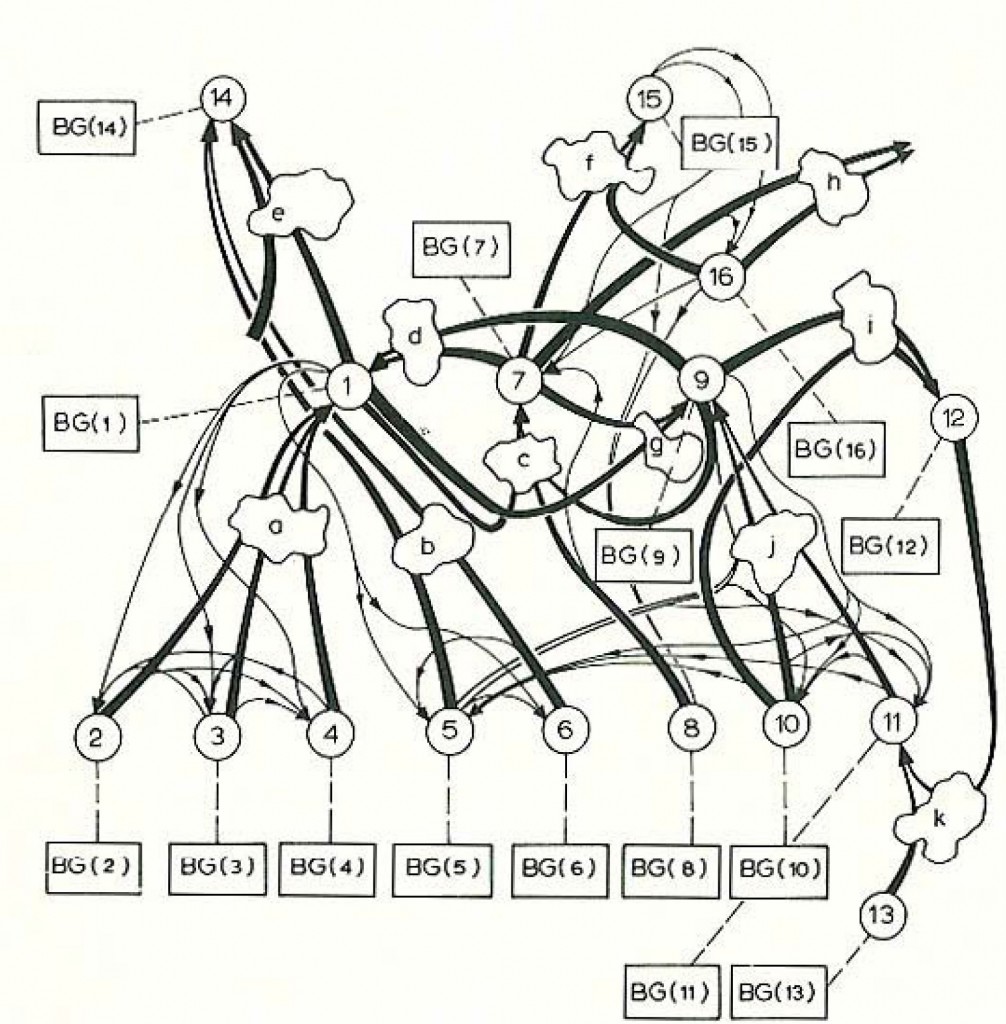
Paskian Feedback Loop Diagram
For me the delights of architectural education have always been the insights that reveal the fluid, dynamic, changing and cyclic nature of architecture. Let us consider architecture as a process and as a unique creative act that happens, not only as a part of the architect’s design methodologies but also as a cognitive act that is fundamental to our perception and subjective experience of space. In this light architecture can be seen as a time based art that exists in space like a continual piece of music or a perpetual performance.
When we start to see architecture not as inert spaces that we occupy but rather spaces created by our occupation, a complex reciprocal relationship between people and space, culture and architecture becomes apparent. Architecture can now be seen as a time based art that is inseparable from the way people perceive and use it. This cyclic relationship between human activity and architecture sees architecture as an event or series of events in time much like a performance complete with characters and protagonists both human and architectural.
Editors’ Choice ∙ Raga Man
Dear contributors, readers, friends,
This is the first in what will be an ongoing, regular series of Editors’ Choice posts – individual pieces picked from the archive and presented independently as an article here on the matzine blog. Like the zine, the Editors’ Choice articles are curated with several modest intentions in mind;- to offer personal reflections on our physical and cultural environments as they exist; to host intellectual, creative exchange across geographical distinctions; and to act in the provocation of new work, of new ways of thinking and making.
Within in the spirit of these intentions, we encourage discussion & intelligent critique…
_________________________________
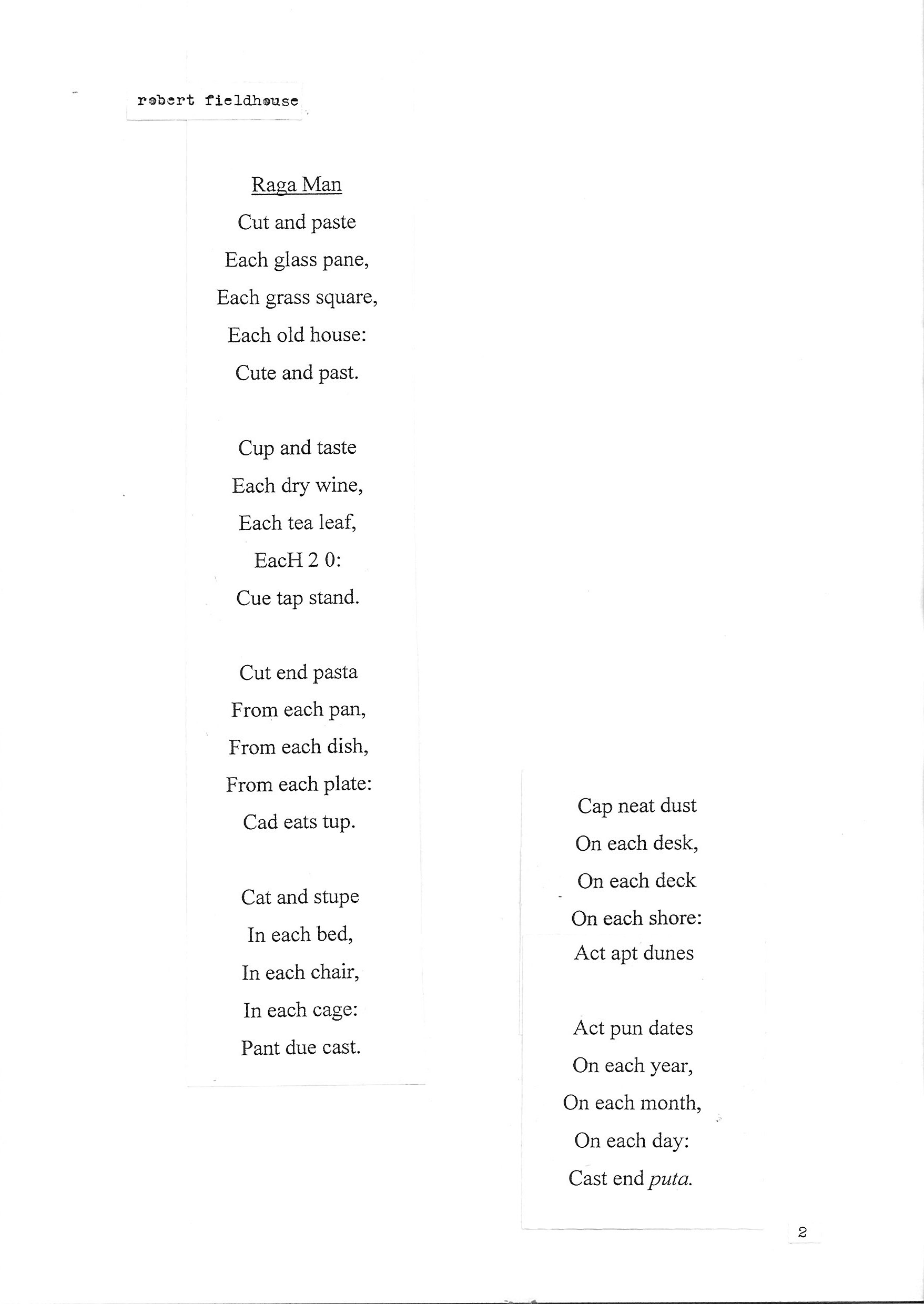
Raga Man, a submission by Robert Fieldhouse to the Copy Paste issue; I really like it. Playful, cunning and quick, this poem delights, beguiles and tickles. These stunted stanzas follow formats seemingly simple, allowing the conscience an unencumbered phonetic, rhythmic pleasure. It reminds me of the Oulipo experiments:
“the seeking of new structures and patterns that may be used by writers in any way they enjoy.” Constraints are used to trigger new ideas and the Oulipo group is an ongoing source of novel techniques, often based on mathematical ideas — such as counting letters and syllables, substitution algorithms, permutations, palindromes, and even chess problems.”
…from Joanna Growney’s blog poetrywithmathematics, also reference in a post from my blog, Dec 2010. As an editor of Matzine it warmed my heart how this submitted piece merrily shook hands with Stephen Mackie’s chosen theme Copy Paste. Reading, I feel like like the words, the words’ meanings and the newly formed verses were each in some way copied and pasted. How abstract a thing to communicate. The references, the less-obvious poetic formulas, the subject-weaves; I am content to carousel these lines with simple survey, though perhaps there are deeper dimensions to be enjoyed upon more rigorous readings of Robert’s Raga Man


 esmefieldhouse
 rowan
rowan ryanmcloughlin
 seán
seán stephen
 Ian Pollard
 matzine
leave a comment