4 weeks to-go : matzine#12 countdown
Four weeks to-go until submission deadline for the decidedly-winterly matzine#12 issue!
To help set your minds in rich places we [Seán & Stephen] will offer you a weekly fragment from our own investigations, while at the same time building up to the fast approaching 1st december
***
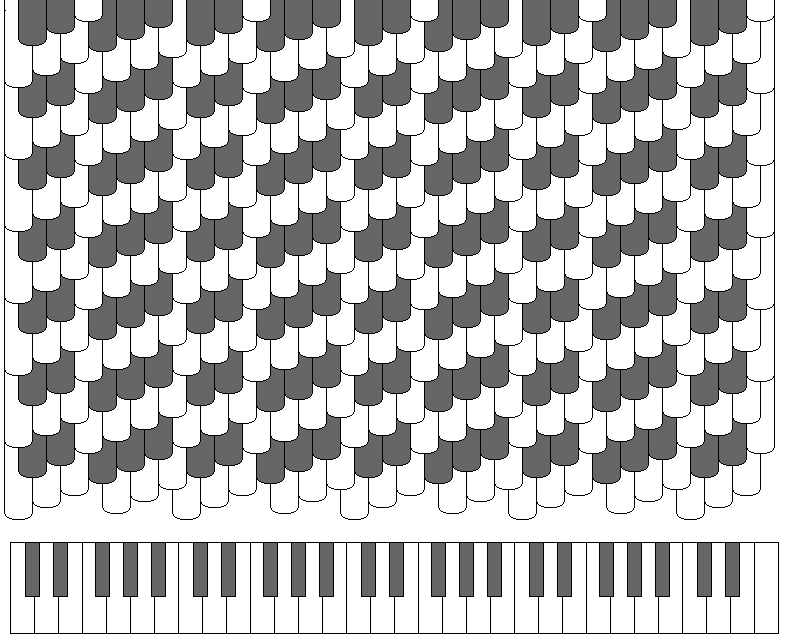
Image : The keyboard of the Enharmonic Harmonium of Bosanquet, constructed around 1876, an instrument for playing 53-notes/intervals per octave! Author of drawing is unknown, though sourced from here.
Ever wondered why the keys on a piano are arranged the way they are? Or why singers jump between notes of a song, rather than sliding between them? In preparation for my submission to matzine#12 I found myself wanting to explore music. And in particular, to understand what a “semi-tone” is, or what the term refers to. Well the above Harmonium described by the diagram above is a musicologists attempt at defining infinitely transposable tonal intervals. Simplified: Robert Bosanquet’s answer was to fit 53 micro-tones in the same space our modern day piano has 12 “semi-tones”.
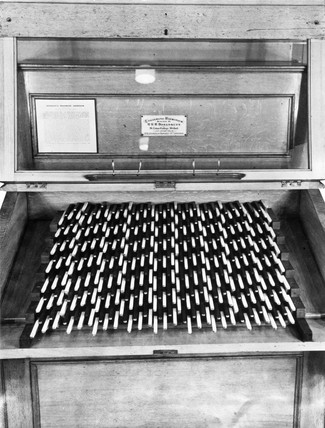
Image : the Enharmonic Harmonium of Bosanquet. This photograph was found on page 49 of Music and Mathematics: From Pythagoras to fractals
It is thought that tonal harmonies were first discovered amongst humans by our hunter-gatherer ancestors, as they sang during work and rituals. The most rudimentary harmony, that of notes separated by an octave [this is mathematically described as the ratio of the frequencies being 2:1, e.g. 440Hz : 220Hz], would have developed so that men and women of different ages could make their collective sound conform, rather than remain disparate, creating tension. Far fetched, though fascinating all the same. How much of what-we-now-call harmony/consonance and discord/dissonance is cultural conditioning and how much of it is human instinct?
– Seán
matzine#12 call for submissions
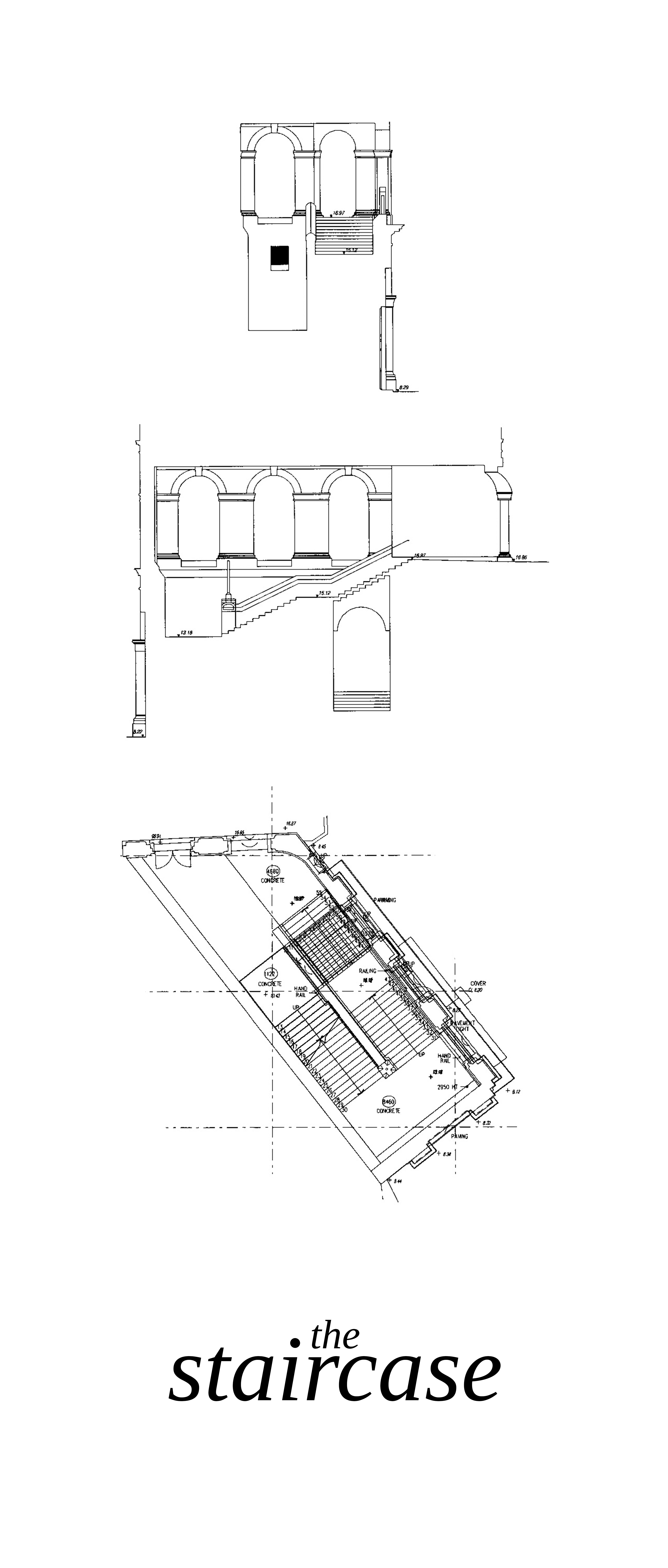 image: southwest holborn viaduct gatehouse, sections & plans by michael gallie & partners, 2006
time to get a-thinking for the next issue! creatively base your submissions on the above stimuli,
following these submission guidelines
the deadline for the winter issue of matzine#12 is
1st december
this issue is edited by
Editors’ Choice ∙ Raga Man
Dear contributors, readers, friends,
This is the first in what will be an ongoing, regular series of Editors’ Choice posts – individual pieces picked from the archive and presented independently as an article here on the matzine blog. Like the zine, the Editors’ Choice articles are curated with several modest intentions in mind;- to offer personal reflections on our physical and cultural environments as they exist; to host intellectual, creative exchange across geographical distinctions; and to act in the provocation of new work, of new ways of thinking and making.
Within in the spirit of these intentions, we encourage discussion & intelligent critique…
_________________________________
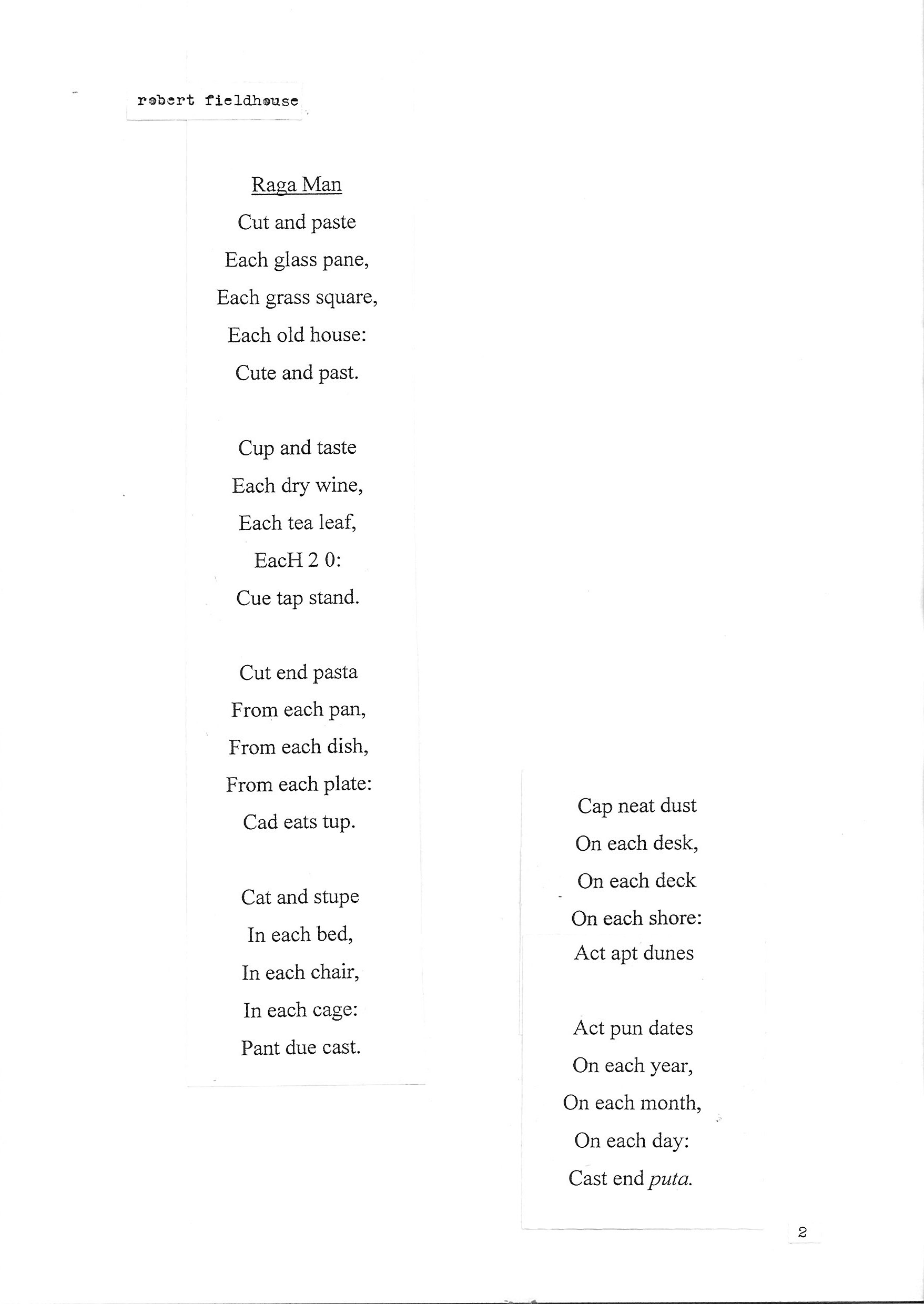
Raga Man, a submission by Robert Fieldhouse to the Copy Paste issue; I really like it. Playful, cunning and quick, this poem delights, beguiles and tickles. These stunted stanzas follow formats seemingly simple, allowing the conscience an unencumbered phonetic, rhythmic pleasure. It reminds me of the Oulipo experiments:
“the seeking of new structures and patterns that may be used by writers in any way they enjoy.” Constraints are used to trigger new ideas and the Oulipo group is an ongoing source of novel techniques, often based on mathematical ideas — such as counting letters and syllables, substitution algorithms, permutations, palindromes, and even chess problems.”
…from Joanna Growney’s blog poetrywithmathematics, also reference in a post from my blog, Dec 2010. As an editor of Matzine it warmed my heart how this submitted piece merrily shook hands with Stephen Mackie’s chosen theme Copy Paste. Reading, I feel like like the words, the words’ meanings and the newly formed verses were each in some way copied and pasted. How abstract a thing to communicate. The references, the less-obvious poetic formulas, the subject-weaves; I am content to carousel these lines with simple survey, though perhaps there are deeper dimensions to be enjoyed upon more rigorous readings of Robert’s Raga Man


 esmefieldhouse
 rowan
rowan ryanmcloughlin
 seán
seán stephen
 Ian Pollard
 matzine
leave a comment